
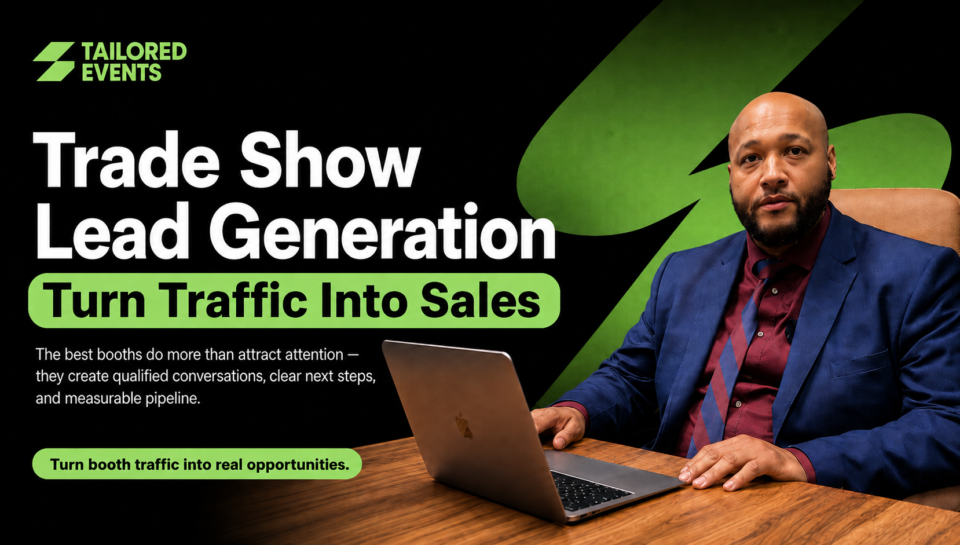
Trade shows create an unusual marketing environment.
Hundreds or thousands of potential customers may be physically present in the same location. Competitors are nearby. Decision-makers are actively exploring solutions. Brands invest heavily in booth space, travel, displays, sponsorships, demonstrations, and promotional material.
And yet many companies leave with a spreadsheet full of names instead of a pipeline full of opportunities.
That is the difference between trade show traffic and trade show lead generation.
A successful booth does not simply attract attendees.
It creates a repeatable process for identifying the right people, starting useful conversations, understanding their needs, demonstrating relevance, capturing context, and giving the sales team a clear next step.
Trade Show Lead Generation Starts Before the Show
The most important trade show conversations may happen on the event floor, but the strategy begins before anyone enters the venue.
Brands should know:
Who they want to meet.
Why those people should care.
What problem the company can help solve.
What the representative needs to learn during the conversation.
What qualifies someone as a worthwhile lead.
What action should happen next.
Without those answers, representatives are forced to improvise.
That often creates a familiar result: plenty of scans, cards, and form submissions with very little information about who is genuinely interested.
Cvent’s trade show lead generation guidance emphasizes that lead generation remains one of the central ways organizations evaluate trade show success and that the quality of those leads ultimately matters when they progress toward customers (https://www.cvent.com/en/blog/events/trade-show-lead-generation).
That means lead quality should be designed into the campaign from the beginning.
Stop Treating Every Attendee as a Lead
A badge scan is not automatically a sales opportunity.
Neither is a business card.
A qualified trade show lead should give the sales team enough context to understand why follow-up is worthwhile.
Qualification will differ by business, but useful information can include:
Role or decision-making influence.
Company type.
Current solution.
Business challenge.
Product or service interest.
Timeline.
Budget context.
Purchase intent.
Desired next step.
A five-minute conversation with the right prospect can be more commercially valuable than fifty anonymous badge scans.
This is one reason Cvent’s current trade show guidance focuses on capturing, qualifying, and routing leads rather than simply collecting contact details (https://www.cvent.com/en/event-marketing-management/cvent-icapture).
The goal should be intelligence, not just volume.
Design the Booth Around Conversation
Booth design matters.
But the strongest trade show booth is not necessarily the one with the biggest screen.
It is the one that makes the desired customer behavior easier.
Can attendees quickly understand what the company does?
Is there a clear reason to stop?
Can representatives begin conversations naturally?
Is there enough space for a demonstration?
Can people move from curiosity into a deeper discussion without blocking the entire booth?
Can leads be captured without creating friction?
The physical environment should support the sales process.
Tailored Events USA builds customized event plans around buyer journeys, offers, scripts, demonstration flows, staffing, and performance measurement (https://tailoredeventsusa.com/our-services/).
That approach is useful because the booth and the sales process should not be designed separately.
Give People a Reason to Stop
Trade shows are competitive attention environments.
Attendees are surrounded by brands asking for a moment of their time.
The opening interaction therefore needs to create relevance quickly.
A representative should usually avoid leading with a long company description.
A better approach is often a concise question or observation that relates to the target customer’s problem.
For example:
What are you currently using for this?
What are you hoping to improve this year?
Are you responsible for this area of the business?
Have you already looked at alternatives?
The exact question depends on the campaign.
The principle does not.
Good trade show engagement begins by involving the attendee in the conversation rather than immediately delivering a memorized pitch.
Use Demonstrations to Create Understanding
Trade shows are particularly valuable for offers that benefit from demonstration.
A strong demo gives attendees something concrete to evaluate.
For physical products, that may mean seeing or trying the product.
For technology or services, it may mean showing a workflow, result, use case, or practical scenario.
But demonstrations should be built around the customer’s need.
Showing every feature usually creates unnecessary complexity.
The representative should understand enough about the visitor to focus on the part of the demonstration that is actually relevant.
This makes the experience feel more personal and increases the likelihood that the prospect understands the value of the offer.
Tailored Events USA specifically identifies B2B companies running demo-heavy activations and trade shows among the types of clients it supports (https://tailoredeventsusa.com/about-company/).
For those campaigns, trained representation becomes especially important.
Staff Quality Changes Lead Quality
A trade show representative does more than welcome people to a booth.
They influence who stops, what gets discussed, what information is captured, how accurately the brand is represented, and whether a promising conversation advances.
This requires preparation.
Representatives should understand:
The ideal customer profile.
The product or service.
The core value proposition.
Qualification questions.
Common objections.
Demonstration flow.
Brand standards.
Lead capture requirements.
When to bring in a specialist.
What next step to request.
Tailored Events already has a dedicated article explaining how poor event staffing can weaken experiential marketing ROI. Its broader service model reinforces the same principle through trained event teams and standardized execution.
At a trade show, staffing should therefore be viewed as part of the lead-generation strategy rather than an operational afterthought.
Capture Context, Not Just Contact Information
Imagine two leads arrive in the CRM.
Lead A contains:
John Smith
ABC Company
[email protected]
Lead B contains:
John Smith
ABC Company
Operations Director
Currently evaluating two providers
Primary issue: deployment time
Interested in enterprise package
Decision expected this quarter
Requested demo with technical team
Both contacts came from the same trade show.
Only one gives sales a meaningful starting point.
That additional context can dramatically improve follow-up.
Cvent’s 2026 guidance on trade show lead capture frames the challenge as a process extending from pre-show targeting through on-site qualification and ultimately into pipeline conversion (https://www.cvent.com/en/blog/events/how-effectively-collect-leads-trade-shows).
That is a useful way to think about lead capture.
The trade show is not the end of the journey.
It is one stage inside it.
Create Lead Categories Before the Event
Not every qualified contact needs the same follow-up.
A simple categorization system can make post-show action much easier.
For example:
High priority: clear need, decision-maker involvement, active timeline.
Medium priority: relevant business and interest, but no immediate buying window.
Long-term nurture: good fit but early in research.
Partner or relationship opportunity: strategically useful contact without direct purchase intent.
Not relevant: does not match the target customer profile.
The exact labels can change.
What matters is giving representatives a consistent system.
That allows sales teams to prioritize the strongest opportunities instead of processing hundreds of event contacts in chronological order.
Follow-Up Speed Matters, but Relevance Matters More
Many brands understand that trade show leads should be followed up quickly.
The problem is what the follow-up says.
A generic message such as “Thanks for stopping by our booth” wastes much of the information gathered during the conversation.
A stronger follow-up references what actually happened.
The challenge the person mentioned.
The product they discussed.
The demo they viewed.
The resource they requested.
The next step they agreed to.
Marketing automation can support the process, but it should preserve customer context rather than eliminate it.
HubSpot’s event marketing tools are designed around connecting lead generation, engagement, follow-up, and customer information within the same broader marketing system (https://www.hubspot.com/marketing-hub-for-events).
Technology becomes most useful when it helps teams continue a real conversation.
Measure the Full Trade Show Funnel
A trade show should not be evaluated only by the number of leads generated.
The more useful funnel looks something like:
Attendees engaged.
Meaningful conversations.
Demonstrations.
Qualified leads.
Meetings requested.
Opportunities created.
Pipeline value.
Closed customers.
Customer acquisition cost.
Post-event conversion.
This prevents teams from optimizing for the wrong number.
For example, a booth may collect fewer leads than another event but create significantly more qualified opportunities.
That event may actually be the better investment.
Tailored Events USA already uses weekly scorecards focused on conversations, demos, sign-ups, sales, wins, leaks, and actions for improvement as part of its experiential marketing model (https://tailoredeventsusa.com/our-services/).
The same performance mindset can be applied specifically to trade shows.
Learn From the Conversations
Trade shows create a concentrated source of customer intelligence.
In a matter of days, a company can hear dozens or hundreds of reactions to its product, pricing, positioning, competitors, and messaging.
That feedback should not disappear once the booth is dismantled.
Teams should document:
Most common objections.
Most effective opening questions.
Features customers asked about.
Competitors mentioned.
Reasons prospects hesitate.
Unexpected use cases.
Questions representatives struggled to answer.
Messages that generated strong engagement.
This information can improve sales enablement, website content, future campaigns, product messaging, and subsequent trade shows.
The event becomes a research environment as well as a lead-generation channel.
Connect Trade Shows With the Wider Customer Journey
A trade show should not exist in isolation from the rest of marketing and sales.
Prospects may visit the company’s website before attending.
They may research it again after the event.
They might receive email follow-up.
They may speak with another sales representative.
They could attend a later demo.
They may compare multiple providers.
McKinsey has long argued that businesses should look at complete customer journeys rather than optimizing isolated touchpoints (https://www.mckinsey.com/capabilities/growth-marketing-and-sales/our-insights/from-touchpoints-to-journeys-seeing-the-world-as-customers-do).
That principle applies directly to trade shows.
The booth conversation should make the next interaction better.
The next interaction should build on what happened at the booth.
A Busy Booth Is Not the Goal
Trade show success is easy to misread.
A crowd looks impressive.
Stacks of scanned badges look productive.
A high number of giveaways creates activity.
But none of those outcomes necessarily creates pipeline.
The real objective is to make it easier for the right potential customers to discover relevance, understand the offer, have a useful conversation, and move toward an appropriate next step.
That requires more than booth traffic.
It requires planning.
It requires trained people.
It requires a qualification process.
It requires useful lead data.
It requires follow-up.
And it requires measurement.
Brands preparing for an upcoming trade show can explore Tailored Events USA’s experiential marketing and event staffing services (https://tailoredeventsusa.com/our-services/), learn more about the company’s experience with B2B and demo-driven activations (https://tailoredeventsusa.com/about-company/), or discuss a future campaign directly with the team (https://tailoredeventsusa.com/contact-us/).
The goal is not to leave the trade show with the most names.
It is to leave with the right conversations moving forward.