
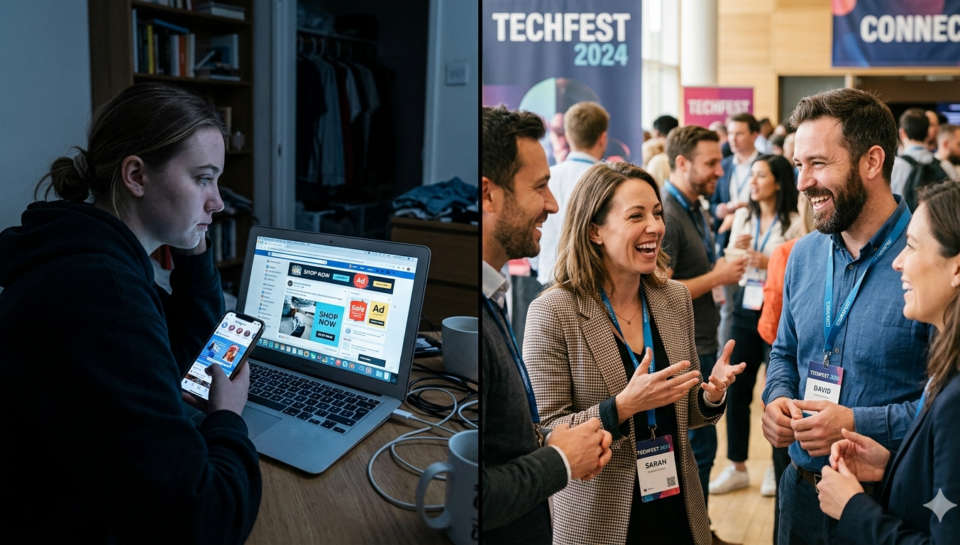
In today’s saturated digital landscape, brands are competing for attention more than ever. Ads are everywhere, inboxes are full, and users scroll faster than they read. While digital marketing continues to evolve, many companies are facing the same frustrating reality: traffic is increasing, but conversions are not.
According to recent insights shared by platforms like HubSpot, businesses are investing more in digital channels than ever before, yet conversion rates remain inconsistent across industries.
This is where in-person marketing is making a strong comeback.
Instead of relying on impressions and clicks, businesses are rediscovering the power of real human interaction. When a potential customer can speak directly with a brand representative, ask questions, and experience a product or service in real time, the entire decision-making process changes. Trust is built faster, objections are handled instantly, and the path to purchase becomes significantly shorter.
This approach is not new, but it has become more relevant than ever. In fact, research highlighted by Forbes Business Council suggests that personalized, human-centered experiences are becoming a key differentiator in competitive markets.
Companies that implement structured in-person campaigns are seeing stronger results because they are not just generating awareness they are driving action. Many of the most effective campaigns today follow a simple but powerful flow: conversation, demonstration, offer, and close.
What makes this model even more effective is the ability to execute it strategically. Businesses that partner with specialized teams offering sales event marketing services are able to turn these interactions into measurable growth. Instead of hoping that a lead converts days later, they create opportunities for immediate engagement and decision-making.
Another key advantage is the quality of leads. Digital campaigns often prioritize volume, but in-person marketing focuses on intent. The people who engage are already interested, already present, and far more likely to convert. This aligns with broader marketing findings published by McKinsey & Company , which emphasize the importance of meaningful customer interactions in driving revenue.
Of course, this does not mean digital marketing is obsolete. On the contrary, the most successful companies are those that combine both strategies effectively. Digital channels generate visibility and bring attention to the brand, while in-person experiences convert that attention into actual revenue. When these two approaches work together, they create a complete and scalable marketing system.
Businesses looking to grow faster are already moving in this direction. By leveraging proven event-based strategies and working with experienced teams like the one behind Tailored Events, they are able to launch campaigns in new markets, replicate successful formats, and build a predictable pipeline of customers.
Ultimately, the difference comes down to connection. People don’t just buy products or services—they buy confidence, clarity, and trust. And those elements are much easier to achieve through real conversations than through a screen.
If your current marketing strategy is generating visibility but not delivering consistent results, it may be time to rethink the approach. Integrating in-person experiences into your strategy could be the missing piece that transforms interest into action.
For businesses ready to take that next step, exploring a more direct and human-centered approach can make all the difference. You can learn more about how these strategies are applied in real campaigns or get in touch with the team to start building a more effective growth system.